A Stadium Beside the City or Beyond It?
Compare an urban stadium with an edge-of-town venue to judge how location shapes matchday routes, arrival choices, and the experience of finding your seat.
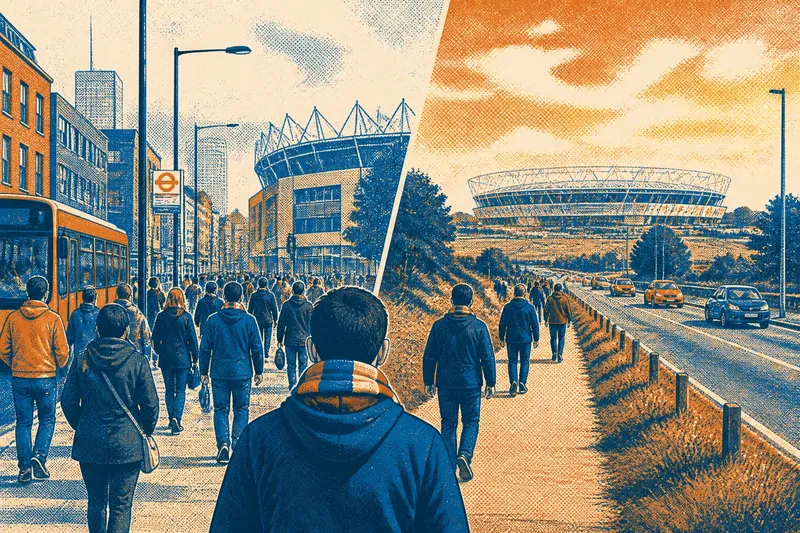
The difference between a stadium in the city and one on its edge is easiest to see in the journey to the gates. An urban stadium is usually reached through an established street network; an edge-of-town venue more often announces itself as a distinct destination. That contrast affects how spectators plan an arrival and what they encounter along the way.
Urban and edge-of-town stadiums occupy different patterns of development
An urban stadium stands among a dense mix of streets and buildings, often within walking distance of transit stops and several routes into the district. An edge-of-town stadium sits near the boundary of continuous development, where larger parcels, major roads, or rail corridors may shape the approach.
“Edge” describes a venue’s relationship to nearby development, not its distance from downtown. A site once beyond town can become part of a growing district, while a central stadium can feel separated from surrounding blocks by highways, tracks, or restricted access.
For a useful comparison, look at the routes that actually meet the entrances. A city-center address does not tell you whether a crossing is straightforward, and an edge location does not tell you whether transit reaches the gates.
Stadium setting changes the character of arrival
At an urban stadium, the approach may pass through established commercial streets or transit corridors. Spectators can have several ways to reach the venue, but event crowds share space with buses, deliveries, and people going about their day. A short route can still feel awkward if it crosses a busy road or funnels everyone onto one narrow sidewalk.
An edge-of-town venue may have a clear approach from a major road and open views of the grounds. If nearby destinations are spread out, though, arriving on foot or by transit can require a less direct route. The setting gives no automatic answer: the useful question is whether the available routes connect the stadium to the places spectators are coming from.
Say you are going to an invented match at a city stadium and your bus stops on a crowded main street. You check the map, see a parallel street that connects to the same entrance, and choose that route; the expected result is an approach that avoids the busiest stretch, though the alternate street may add a turn or a short walk. The tradeoff is clearer movement against a less direct path.
Compare stadium settings by checking specific connections
A street map can show possible routes, while a visit at a quiet time can reveal whether they are open and legible. For each observation, decide what it means for the journey and what alternative you would use if the route does not work.
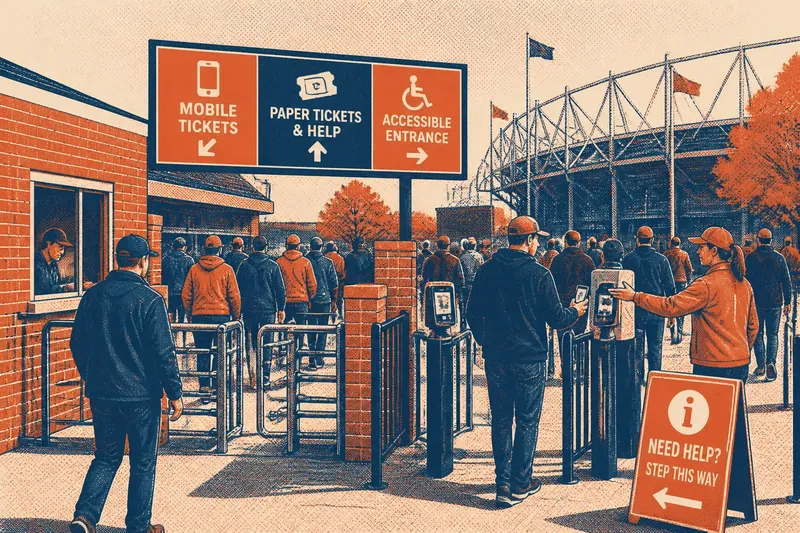
- Entrance connections: Check whether entrances meet several streets or one main approach. If several routes are open, choose the one that fits your starting point; if access funnels through one route, allow for crowding or select another entrance when available.
- Transit access: Check whether a station or bus stop has a continuous, clear path to the gates. If it does, transit may be practical; if a barrier interrupts the route, look for another stop or compare a different travel mode.
- Street crossings: Check for major roads, tracks, or crossings between the venue and likely arrival points. If a safe crossing connects them, use it; if not, choose a route with a suitable crossing rather than relying on apparent map distance.
- Walking and cycling approaches: Check whether sidewalks and cycling routes continue to the stadium entrance. If they do, those modes may offer a direct arrival; if they end abruptly, identify a connected route or plan another mode.
- Event-day road access: Check where vehicles approach and whether roads converge near the gates. If several approaches remain usable, follow the route that matches your arrival direction; if traffic concentrates on one road, consider transit or an alternate approach.
- Wayfinding: Check whether signs and visible landmarks make the route easy to follow. If the entrance is clear, use that landmark to stay oriented; if directions become ambiguous, save a map route or choose a better-marked approach.
How can you tell which setting suits your trip?
Does an urban stadium always offer more ways to arrive?
No. An urban venue may sit near transit and connected streets, but barriers or limited entrances can narrow the practical choices. Check the full route from your starting point instead of relying on the venue’s city address.
Is an edge-of-town stadium always car-dependent?
No. Some edge venues have direct rail or bus connections, while others have approaches that favor driving. Check whether transit or walking routes reach the gates without a difficult gap.
What matters more, distance or route quality?
Route quality can matter more than distance on a map. A nearby stop may be separated from the stadium by a road or rail line, while a longer route may have a continuous sidewalk and clear crossings.
How should you choose between two arrival routes?
Compare where each route begins, how it reaches the gates, and whether it depends on a single crowded approach. Choose the route with clear connections; if it is likely to be busy or blocked, keep a suitable alternative in mind.
Stadium location shapes the memory of arrival
Supporters often remember not only the building but also the approach: a view across the skyline, a station exit, or the road that brings the grounds into sight. Urban venues can be associated with a distinct sequence of city streets; edge venues may be remembered as a destination reached through a more open approach.
Those impressions are personal, so a photograph of the stadium cannot settle which setting is easier or more distinctive. What matters for a particular visit is the route you will use, the choices available if it is crowded, and how clearly the grounds can be reached from your starting point. That is the most practical way to compare a stadium in the city with one beyond it.