From Turnstiles to Ticket Scanners: The Stadium Entrance
Stadium entrance design shapes how crowds arrive, wait, and remember a matchday, from the steady rhythm of turnstiles to flexible digital ticket checks.
A stadium entrance can turn an arrival into a steady procession or a queue that stalls before the gates. Stadium entrance design has changed from rows of mechanical turnstiles to systems that may combine ticket scanners, staff, barriers, and several ways to verify admission. That shift is about more than replacing a metal arm with a screen: it changes how a venue organizes access and how the crowd experiences the threshold.
The entrance is a sequence, not a single gate
People often call the whole approach to the stands “the gate,” but an entrance is a chain of decisions. A visitor may approach a plaza, find a section or gate letter, join a queue, present a ticket, pass through a barrier, and then locate a stairway or concourse. Each point can help people move on or send them searching for information.
Older turnstile layouts made the admission point easy to recognize. The rotating bars controlled passage, while a ticket clerk or attendant checked the ticket nearby. Because the mechanism admitted people in a narrow, repeated rhythm, its location and capacity shaped the queue that gathered outside. A turnstile was both a device and a visible sign that the boundary had been crossed.
Digital entry changes that pattern. A scanner reads a code from a paper ticket or phone, but it does not, by itself, decide how people approach, wait, or recover from a failed scan. The surrounding design still matters: signs need to show where to go, lanes need to remain legible, and staff need room to help without blocking everyone behind them.
A hypothetical venue learns where its entrance really begins
Imagine a fictional neighborhood baseball park called Alder Field. Its old main entrance has a brick ticket booth, a short row of turnstiles, and one wide approach shared by spectators, visitors seeking the ticket window, and people looking for an accessible route. The team decides to introduce mobile tickets and handheld scanners while keeping the familiar turnstiles in place for paper admission.
On the first planned matchday, the venue’s staff expect the new scanners to make the queue simpler. Instead, arriving visitors bunch near the first device. Some have opened their tickets before reaching the gate; others are still looking for the right message on their phones. A few paper-ticket holders head toward the scanner lane, while people with questions stop in the middle of the approach. The entrance’s main problem is not the scanner’s reading speed. It is that the layout gives different visitors no clear place to choose what to do.
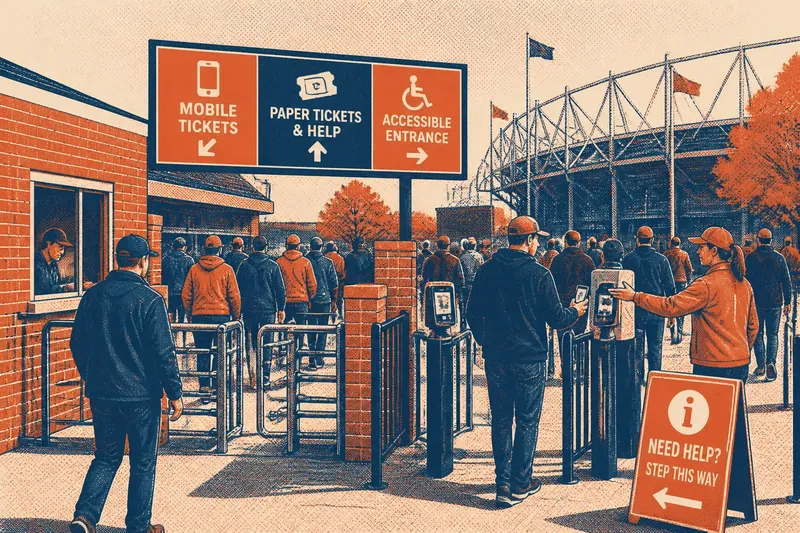
The fictional venue responds by treating the approach as part of the entrance. Signs at the edge of the plaza identify mobile-ticket lanes, paper-ticket help, and the accessible entrance. Staff stand before the scan point, where they can direct people without interrupting the person presenting a ticket. The former ticket booth remains a recognizable landmark, but its role is made clear so visitors do not queue there by habit when they need another kind of help.
At the next home game in this invented situation, visitors separate into more understandable lines before reaching the scanners. People with a ticket problem can step aside to speak with staff, while others continue through the marked lanes. The change does not remove every delay, but the observable result is a less confused approach: fewer people stop at the barrier to decide where they belong, and the entrance feels like a sequence with distinct purposes.
Alder Field’s lesson is that a new admission tool cannot compensate for an unclear arrival. The useful design question is not simply “Where does the scanner go?” It is “Where can a person understand the next action, and where can they ask for help without halting the flow?”
Turnstiles made access physical and repeatable
A mechanical turnstile gives the entrance a simple physical logic. A person presents a ticket, an attendant checks it, and the bars rotate as that person passes. The device helps regulate movement through a narrow opening, while the repeated motion makes admission visible to the crowd and staff.
That logic also has limits. A turnstile takes up space, and a row of them can make the gate feel like a boundary rather than a welcome. A visitor who needs more time, uses a mobility aid, or has a ticket question may require a different path or assistance. Good entrance planning therefore treats accessible admission and staff support as part of the main system, not as afterthoughts.
Turnstiles also carried a particular matchday rhythm. Their clatter and repeated movement marked the moment when people left the street and entered the stadium. For regular visitors, the turnstile could become a familiar part of arrival, as ordinary as a landmark outside the ground or the route to a favored stand. Replacing it can alter a small but recognizable piece of how the venue is remembered.
Scanners shift the work from the barrier to the whole arrival
A digital ticket check can be placed across more than one lane and can work with paper or phone-based tickets, depending on the venue’s system. It can also make the admission point less dependent on a single ticket booth. But the ticket on a screen brings practical questions that a printed stub did not: Is the display ready? Is the code easy to find? Does brightness or a damaged screen interfere with a scan?
Those questions make wayfinding and assistance especially visible. Clear gate names, signs that can be read before a person joins a queue, and a staff member who can direct visitors all reduce uncertainty. A venue can also distinguish between a lane for straightforward admission and a nearby place to resolve ticket issues. The purpose is not to make every visitor follow an elaborate route; it is to keep one problem from stopping everyone behind it.
Digital access can also make the entrance feel less like a row of individual mechanical passages and more like a managed field of movement. That flexibility may help a venue adapt a plaza or concourse for different events, but it asks more of the people running the gates. Staff must be able to notice when a visitor needs help, explain the choices simply, and keep the entry point understandable when devices or networks behave unpredictably.
Design the threshold around the decisions visitors face
For a stadium considering a change, the most useful observations happen before and just after the ticket check. Notice where arriving groups pause, where they turn back, and which signs people can see from the approach. Watch whether visitors can distinguish the line for admission from the place to ask a question. These ordinary details reveal whether the entrance communicates its layout.
A venue can use a short planning list to make those observations concrete:
- Approach: If visitors can see the correct gate before joining a queue, keep the sign in that position; if they cannot, move or add a sign where they choose their route.
- Queue choice: If paper tickets, phone tickets, and ticket questions have clearly marked routes where needed, retain those distinctions; if not, mark the options before the scanning point.
- Accessible admission: If the accessible route is easy to identify and connected to staff assistance, keep both visible from the approach; if not, clarify the route and position help where visitors can find it.
- Failed scan: If someone can step aside without blocking a lane, keep that support space clear; if not, create a nearby help point for a brief conversation.
- After entry: If visitors can find their stand or concourse without doubling back, preserve the visible direction; if not, add wayfinding immediately after admission.
- Regular visitors: If a familiar booth or gate still suggests a service it no longer provides, explain its current role; if visitors already understand the change, keep the landmark but avoid adding redundant instructions.
It is usually not worth trying to make every part of the arrival feel like a new technology experience. Decorative screens or a complicated sequence of instructions add little if visitors still cannot tell which line to join. A plain sign, a visible staff member, and room to pause can do more for clarity than another display.
What do visitors ask about stadium entrance design?
Do stadium turnstiles still have a role?
They can remain useful where a venue wants a familiar, controlled passage for certain tickets or event arrangements. Their value depends on the surrounding layout, including accessible routes, staff support, and enough space for visitors to choose the right entrance.
What happens if a digital ticket will not scan?
A well-arranged gate gives the visitor a nearby way to ask for help without standing in the scan lane. Staff can direct the person to the venue’s ticket-support process, while the rest of the queue continues forward.
How can a stadium make its entrance easier to understand?
Put clear gate information where people approach, distinguish admission lanes from help points, and show the direction to the stands after the ticket check. A visitor should not need to reach the barrier before learning what to do.
Does digital ticketing change the atmosphere of arrival?
It can change the sounds and gestures people associate with entering, replacing the clatter and repeated movement of turnstiles with a quieter scan and a confirmation on a screen. The larger atmosphere still comes from the crowd, the building, and the familiar routines gathered around the gate.
The entrance becomes part of a stadium’s memory
The most successful transition from turnstiles to scanners does not erase the history of the entrance. It recognizes that people remember where they met friends, where they waited for a late arrival, and which gate led toward their section. A former ticket booth can remain a useful landmark even when its original job changes, provided the venue makes that change easy to understand.
In stadium entrance design, technology is only one part of access. The deeper shift is from controlling a single opening to coordinating an arrival: directing people, accommodating different needs, and making room for questions. When a venue gets those choices right, the crowd can move across the threshold with less uncertainty, while the entrance keeps its place in the shared memory of matchday.