When the Matchday Crowd Is Gone
See how a stadium changes between events by noticing its working routines, quiet sounds, and altered spaces, and understand its everyday role beyond matchday.
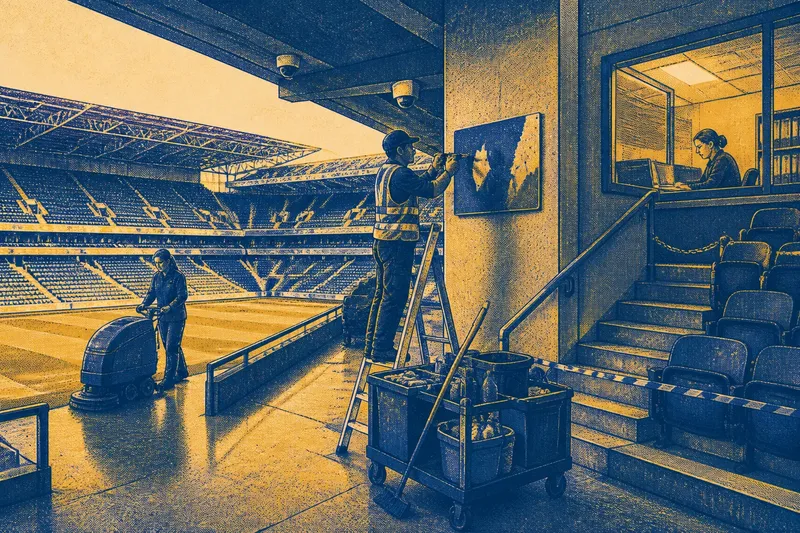
A stadium’s ordinary-day life is easiest to see in the work that keeps it ready. When the crowd is gone, cleaning carts, maintenance tasks, office routines, and delivery schedules reveal another identity for the building: not a place waiting for a match, but a workplace with its own rhythms.
Everyday work gives the stadium a second identity
During an event, attention gathers around the field and the spectators. Away from that schedule, staff may be repairing a seat, preparing an office, restocking a kitchen, or cleaning a concourse. These tasks are not backstage details in the sense of being unimportant; they are the routines that make the venue usable again.
Different parts of the building follow different clocks. A stadium office may keep regular business hours, while a grounds crew works when the pitch is clear and a cleaning team comes through after an event. Looking at those schedules helps explain why one area can feel active while another remains shut.
Look for signs of routine maintenance
Notice where equipment and materials are stored, which surfaces show repeated cleaning, and where protective coverings appear. A cart parked near a stairwell or tools arranged beside a work area can point to a task in progress. These observations describe current activity, but they do not reveal the full maintenance plan on their own.
It is not worth treating every scuff, locked door, or temporary barrier as evidence of neglect. A barrier may protect a repair, and a closed room may simply be outside public access. Look for several related clues, and respect signs that restrict entry.
Say you pass a stadium on a weekday and see a maintenance cart beside a stair, a worker replacing a damaged sign, and a section of seats roped off. The observable pattern suggests that staff are repairing and managing the venue; it does not establish why the sign was damaged or how long the work will take.
Listen for the building’s quieter routines
With spectators absent, ordinary sounds can become more distinct: ventilation, a rolling cart, footsteps in a concourse, or a door closing in a service area. These sounds can help you locate activity, though they rarely identify a task with certainty. A fan’s hum, for instance, may come from routine building systems rather than a specific repair.
Scale also feels different without a crowd. A large stand may recede from attention while a small office window, workbench, or staff counter becomes prominent. Notice what draws your eye, but distinguish what you can see from what you are inferring about the people who use the space.
Record observations without overreading them
A simple note can separate direct observations from interpretations. Write down the location, the visible activity, and what remains uncertain. This keeps a brief visit useful without turning one moment into a claim about the stadium’s entire operation.
- If a maintenance cart is beside a marked work area, record the location and visible task; if no work area is marked, describe the cart without assuming what it is for.
- If a door has a staff-only sign, treat it as restricted; if access rules are unclear, stay in public areas and check venue guidance.
- If equipment is stored neatly near a work zone, note the arrangement; if it is scattered or partly hidden, avoid concluding that the area is unsafe or neglected.
- If a cleaning tool or supply is in use, record the activity you can see; if the area is empty, do not infer that cleaning never occurs there.
- If several related repair clues appear together, describe the pattern; if only one clue appears, keep the explanation tentative.
- If a public office or facility is open, note its posted hours and purpose; if it is closed, check official information rather than trying the door.
What can you learn from an ordinary stadium day?
Can visitors enter when no match is scheduled?
Access depends on the venue and on which spaces are open to the public. Check official visitor information before going, and observe only from areas that are clearly accessible.
Does a quiet stadium mean nobody is working?
No. Staff, contractors, office workers, and facility users may be present without creating the noise or movement associated with a crowd. A quiet seating bowl can sit beside a busy work area.
Can visible wear tell you how well a stadium is maintained?
Not by itself. Wear can reflect repeated use, a temporary repair, or the materials chosen for a particular space; a broader judgment requires more information than a brief public observation provides.
What should you write down during a visit?
Record where you stood, what you directly observed, and what you could not confirm. That makes your notes more useful than a broad impression such as “the stadium was empty” or “the building was neglected.”
Separate visible activity from assumptions
An ordinary-day visit can show who appears to use a stadium and what kinds of work are underway, but it offers only a small view of the venue’s routine. The most reliable description stays close to what is visible: a repair in progress, an open office, or a cleaning cart moving through a concourse.
When you describe the stadium after the matchday crowd is gone, name one task, one place, and one uncertainty. That small distinction makes the building’s quieter life clearer without pretending that a passing glance explains everything happening inside.